
SIU Director’s Report - Case # 25-PVI-404
Warning:
This page contains graphic content that can shock, offend and upset.
Contents:
Mandate of the SIU
The Special Investigations Unit is a civilian law enforcement agency that investigates incidents involving an official where there has been death, serious injury, the discharge of a firearm at a person or an allegation of sexual assault. Under the Special Investigations Unit Act, 2019 (SIU Act), officials are defined as police officers, special constables of the Niagara Parks Commission and peace officers under the Legislative Assembly Act. The SIU’s jurisdiction covers more than 50 municipal, regional and provincial police services across Ontario.
Under the SIU Act, the Director of the SIU must determine based on the evidence gathered in an investigation whether there are reasonable grounds to believe that a criminal offence was committed. If such grounds exist, the Director has the authority to lay a criminal charge against the official. Alternatively, in cases where no reasonable grounds exist, the Director cannot lay charges. Where no charges are laid, a report of the investigation is prepared and released publicly, except in the case of reports dealing with allegations of sexual assault, in which case the SIU Director may consult with the affected person and exercise a discretion to not publicly release the report having regard to the affected person’s privacy interests.
Information Restrictions
Special Investigations Unit Act, 2019
Pursuant to section 34, certain information may not be included in this report. This information may include, but is not limited to, the following:
- The name of, and any information identifying, a subject official, witness official, civilian witness or affected person.
- Information that may result in the identity of a person who reported that they were sexually assaulted being revealed in connection with the sexual assault.
- Information that, in the opinion of the SIU Director, could lead to a risk of serious harm to a person.
- Information that discloses investigative techniques or procedures.
- Information, the release of which is prohibited or restricted by law.
- Information in which a person’s privacy interest in not having the information published clearly outweighs the public interest in having the information published.
Freedom of Information and Protection of Personal Privacy Act
Pursuant to section 14 (i.e., law enforcement), certain information may not be included in this report. This information may include, but is not limited to, the following:
- Confidential investigative techniques and procedures used by law enforcement agencies; and
- Information that could reasonably be expected to interfere with a law enforcement matter or an investigation undertaken with a view to a law enforcement proceeding.
Pursuant to section 21 (i.e., personal privacy), protected personal information is not included in this report. This information may include, but is not limited to, the following:
- The names of persons, including civilian witnesses, and subject and witness officials;
- Location information;
- Witness statements and evidence gathered in the course of the investigation provided to the SIU in confidence; and
- Other identifiers which are likely to reveal personal information about individuals involved in the investigation.
Personal Health Information Protection Act, 2004
Pursuant to this legislation, any information related to the personal health of identifiable individuals is not included.
Other proceedings, processes, and investigations
Information may also have been excluded from this report because its release could undermine the integrity of other proceedings involving the same incident, such as criminal proceedings, coroner’s inquests, other public proceedings and/or other law enforcement investigations.
Mandate Engaged
Pursuant to section 15 of the SIU Act, the SIU may investigate the conduct of officials, be they police officers, special constables of the Niagara Parks Commission or peace officers under the Legislative Assembly Act, that may have resulted in death, serious injury, sexual assault or the discharge of a firearm at a person.
A person sustains a “serious injury” for purposes of the SIU’s jurisdiction if they: sustain an injury as a result of which they are admitted to hospital; suffer a fracture to the skull, or to a limb, rib or vertebra; suffer burns to a significant proportion of their body; lose any portion of their body; or, as a result of an injury, experience a loss of vision or hearing.
In addition, a “serious injury” means any other injury sustained by a person that is likely to interfere with the person’s health or comfort and is not transient or trifling in nature.
This report relates to the SIU’s investigation into the serious injury of a 19-year-old woman (the “Complainant”).
The Investigation
Notification of the SIU[1]
On October 6, 2025, at 10:49 a.m., the Ontario Provincial Police (OPP) contacted the SIU with the following information.
On October 5, 2025, at 8:16 p.m., a Toyota Tundra was reported stolen by the vehicle’s owner. The licence plate was added to the automated licence plate recognition (ALPR) system. At 10:07 p.m., Witness Official (WO) #1’s ALPR picked up the licence plate of the stolen truck. The officer initiated a traffic stop, southbound on Highway 621, Rainy River. The truck did not stop. It continued southbound on Highway 621. The Subject Official (SO) deployed a spike belt. The truck ran over the spike belt, continued for a distance, then took a sharp turn onto Donald Street. The driver, the Civilian Witness (CW), lost control of the vehicle and slid into a ditch. At 10:27 p.m., the SO and WO #1 arrested the CW but were unable to remove the passenger - the Complainant - from the vehicle. The Complainant’s right leg was injured. An ambulance was requested, and the Complainant was transported to the Riverside Health Care Facilities - Rainy River Health Centre where she was confirmed to have suffered a fractured knee.
The Team
Date and time team dispatched: 2025/10/06 at 12:27 p.m.
Date and time SIU arrived on scene: 2025/10/07 at 10:00 a.m.
Number of SIU Investigators assigned: 3
Number of SIU Forensic Investigators assigned: 0
Number of SIU Collision Reconstructionists assigned: 1
Affected Person (aka “Complainant”)
19-year-old female; interviewed; medical records obtained and reviewed
The Complainant was interviewed on October 6, 2025.
Civilian Witness (CW)
CW Not interviewed (declined)
Subject Official (SO)
SO Declined interview, as is the subject official’s legal right; notes received and reviewed
Witness Officials (WO)
WO #1 Interviewed; notes received and reviewed
WO #2 Interviewed; notes received and reviewed
WO #3 Not interviewed; notes reviewed, and interview deemed unnecessary
WO #4 Not interviewed; notes reviewed, and interview deemed unnecessary
The witness officials were interviewed between November 9, 2025, and December 23, 2025.
Evidence
The Scene
The events in question began on Highway 621, a distance north of Highway 11, continued south on Highway 621 and then east on Highway 11, and culminated in and around the intersection of Highway 11 and Donald Street, Dawson.
The stolen truck came to rest in a ditch at the junction of Highway 11 and Donald Street, the location indicated in the below image by the orange arrow.
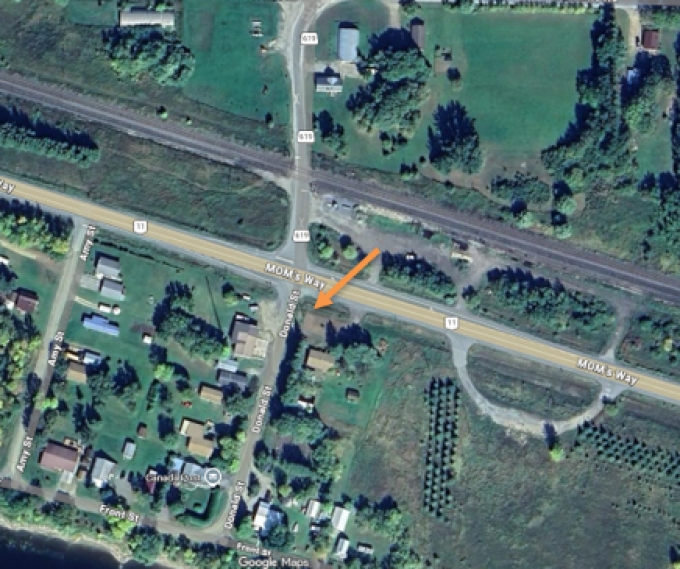
Source: Google maps
The truck faced southeast. A gouge in the road ran in a curved southeast direction into the ditch where the vehicle came to rest.
Expert Evidence
A SIU Collision Reconstructionist reviewed the video footage of the events in question.
Video/Audio/Photographic Evidence[2]
In-car Camera (ICC) Footage
At 11:11 p.m., October 5, 2025, WO #1 was captured following a truck southbound on Highway 621. His police vehicle was about 100 metres behind the truck and both vehicles travelled at about 60 km/h to 70 km/h. A minute later, WO #1 activated his emergency lights and sirens and followed the stolen truck.
The SO was captured stopped along the east shoulder of Highway 621, about 150 metres north of Highway 11. The stolen truck and WO #1’s vehicle could be seen in the far distance. The SO was heard to deploy a spike belt. The truck passed at about 60 km/h and was heard to make impact with the spike belt.
WO #1 slowed, and the truck was no longer seen. He pulled to a stop on the shoulder. The SO passed WO #1’s police vehicle and headed eastbound on Highway 11. WO #1 asked permission via radio to follow at a distance and was approved.
The SO followed the truck at a distance, followed by WO #1. All three vehicles travelled at about 60 km/h at the tail end of the engagement. There was hardly any traffic on the road. The driver of the truck appeared to be struggling to control the vehicle with a disabled wheel.
At 11:22 p.m., the stolen truck attempted a right-hand turn onto Donald Street and entered a ditch. It was travelling at an estimated speed of about 50 km/h.
Body-worn Camera (BWC) Footage
The SO’s and WO #1’s BWC recordings captured post-crash interactions with the Complainant and the CW.
The CW and the Complainant were unable to walk due to injuries. The SO dealt primarily with the Complainant, who occupied the passenger side of the truck. WO #1 dealt with the CW, who occupied the driver side. The SO arrested the Complainant and rendered first-aid. She was not placed in handcuffs. The SO stayed with her until care was transferred to paramedics at 11:50 p.m.
Police Communication Recordings – Radio
On October 5, 2025, the dispatcher advised WO #1 and the SO of the theft of a motor vehicle. WO #1 subsequently advised the stolen vehicle had travelled past him, southbound, on Highway 621, and that he had turned around to follow. The SO made his way to the area.
WO #1 and the SO radioed their plans to set up a spike belt. WO #2 broadcast he was monitoring the call. The SO asked WO #1 to confirm the truck matched the licence plate of the stolen vehicle. WO #1 responded the ALPR matched the plate.
As WO #1 passed Blue Road 1, he advised he would initiate the traffic stop shortly.
At 11:13 p.m., WO #1 broadcast he had his emergency lights and siren activated but the stolen truck continued, at about 60 km/h.
At 11:14 p.m., the SO broadcast the vehicle hit the spike belt and continued eastbound on Highway 11. They were following at a safe distance, with no emergency vehicle equipment activated.
WO #1 broadcast he had pulled over on Highway 11. He requested permission to follow at a distance.
At 11:17 p.m., the SO advised the truck was in the middle of the highway. He was keeping his distance, his emergency lights and siren were not activated, and his speed was approximately 90 km/h, then 70 km/h. The roads were dry, there was no traffic, and the truck was swerving in and out of its lane. The SO reported he was about 50 metres behind.
WO #2 suggested a second spike belt attempt; however, other officers were at least 40 to 50 kilometres away.
At 11:20 p.m., the SO broadcast the stolen truck was going about 65 km/h, and he was concerned with the way it swerved on the road. WO #2 acknowledged and said it would be good to get westbound traffic stopped, but if other police officers were too far out it might not happen. The SO asked that a police vehicle head west and block the westbound lane.
At 11:21 p.m., the SO broadcast he was eastbound, past Church Street, at about 60 km/h, the stolen truck’s front left tire was blown, and the vehicle was braking. He then reported the truck was in a ditch. About six minutes later, the SO broadcast two females were in custody and the Complainant possibly had a broken leg. WO #1 broadcast the CW also complained of a leg injury. Emergency Medical Services were requested.
Materials Obtained from Police Service
Upon request, the SIU obtained the following records from the OPP between October 6, 2025, and October 10, 2025:
- BWC footage – the SO and WO #1
- ICC footage – the SO and WO #1
- Communications recordings
- Computer-aided Dispatch Report
Materials Obtained from Other Sources
The SIU obtained the Complainant’s medical records from the Thunder Bay Regional Health Sciences Centre on October 23, 2025.
Incident Narrative
The evidence collected by the SIU, including interviews with the Complainant and a police witness, and video footage that largely captured the incident, gives rise to the following scenario. As was his legal right, the SO did not agree an interview with the SIU. He did authorize the release of his notes.
In the evening of October 5, 2025, OPP officers in the Fort Frances area were on the lookout for a pick-up truck reported stolen from Rainy River. WO #1 was among the officers searching for the vehicle. While travelling north on Highway 621, WO #1’s ALPR identified the stolen vehicle. It was travelling south past his cruiser. WO #1 turned around and radioed that he had located the pick-up truck.
The SO was south of WO #1’s location and also looking for the vehicle. The two officers decided that the SO would deploy a spike belt across Highway 621, just north of railway tracks north of Highway 11. WO #1 would activate his emergency equipment as they approached the spike belt to signal the pick-up truck driver to pull over. If the pick-up truck did not stop, the belt would be in place to disable the vehicle.
WO #1 turned on his emergency lights and siren as the vehicles approached the train tracks. The pick-up truck did not stop. It travelled over the spike belt and made a left turn onto eastbound Highway 11.
The SO followed the pick-up truck on Highway 11, as did WO #1 after initially stopping for a period. The truck’s front driver side tire was damaged. It failed to execute a right turn onto southbound Donald Street and crashed into the ditch at the southeast corner of the intersection.
The SO and WO #1 arrived at the site of the collision and rendered assistance to the vehicle’s occupants. The driver – the CW – emerged from the vehicle without having suffered a serious injury. The passenger – the Complainant – had fractured her right knee.
Relevant Legislation
Sections 219 and 221, Criminal Code - Criminal Negligence Causing Bodily Harm
219 (1) Every one is criminally negligent who
(a) in doing anything, or
(b) in omitting to do anything that it is his duty to do,
shows wanton or reckless disregard for the lives or safety of other persons.
(2) For the purposes of this section, duty means a duty imposed by law.
221 Every person who by criminal negligence causes bodily harm to another person is guilty of (a) an indictable offence and liable to imprisonment for a term of not more than 10 years; or (b) an offence punishable on summary conviction.
Section 320.13 (2), Criminal Code – Dangerous Operation Causing Bodily Harm
(2) Everyone commits an offence who operates a conveyance in a manner that, having regard to all of the circumstances, is dangerous to the public and, as a result, causes bodily harm to another person.
Analysis and Director’s Decision
The Complainant was seriously injured in a motor vehicle collision on October 5, 2025. As police were engaged with the vehicle in which the Complainant was a passenger at the time of the collision, the SIU was notified of the incident and initiated an investigation. The SO was identified as the subject official. The investigation is now concluded. On my assessment of the evidence, there are no reasonable grounds to believe that the SO committed a criminal offence in connection with the collision and the Complainant’s injury.
The offences that arise for consideration are dangerous driving causing bodily harm and criminal negligence causing bodily harm contrary to sections 320.13(2) and 221 of the Criminal Code. Both require something more than a simple want of care to give rise to liability. The former is predicated, in part, on conduct that amounts to a marked departure from the level of care that a reasonable person would have exercised in the circumstances. The latter is premised on even more egregious conduct that demonstrates a wanton or reckless disregard for the lives or safety of other persons. It is not made out unless the neglect constitutes a marked and substantial departure from a reasonable standard of care. In the instant case, the question is whether there was a want of care on the part of the SO, sufficiently egregious to attract criminal sanction, that caused or contributed to the collision. In my view, there was not.
With information at their disposal that the pick-up truck the CW was operating had recently been stolen, the SO and WO #1 were within their rights in attempting to stop the vehicle.
The plan devised by the officers, including the use of the spike belt, was a reasonable one and reasonably executed. WO #1 would first signal the CW to stop with the use of his emergency lights and siren. If she failed to stop, the spike belt would be in place to immobilize the vehicle. There are always risks associated with a spike belt, such as a loss of control by the subject vehicle, but those risks were attenuated in the circumstances of this case. The roads were dry and there was next to no traffic on the roadways. Indeed, it was not until several minutes after the stolen vehicle went over the spike belt that it lost control and crashed into a ditch. The SO and WO #1 travelled at reasonable speeds through most of their engagement with the pick-up truck and were always a safe distance behind it. Once the collision occurred, the officers acted with dispatch in rendering care to the vehicle’s occupants. On this record, the evidence does not establish that either officer transgressed the limits of care prescribed by the criminal law.
For the foregoing reasons, there is no basis for proceeding with criminal charges in this case. The file is closed.
Date: February 3, 2026
Electronically approved by
Joseph Martino
Director
Special Investigations Unit
Endnotes
- 1) Unless otherwise specified, the information in this section reflects the information received by the SIU at the time of notification and does not necessarily reflect the SIU’s findings of fact following its investigation. [Back to text]
- 2) The following records contain sensitive personal information and are not being released pursuant to section 34(2) of the Special Investigations Unit Act, 2019. The material portions of the records are summarized below. [Back to text]
Note:
The signed English original report is authoritative, and any discrepancy between that report and the French and English online versions should be resolved in favour of the original English report.